Losing Palestine to al-Qaeda
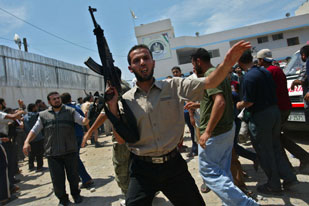
An above the fold front page in today’s New York Times makes a hard-hitting contribution to pulling people's heads out of the sand on Palestinian issues and to realizing that the alternative to Hamas may not be a return to the warm familiarity of Fatah, but rather a lurch in the direction of al-Qaedism. The article “Jihadist Groups Fill a Palestinian Power Vacuum,” looks at the situation both in the Palestinian refugee camps in Lebanon and in Gaza. Steven Erlanger and Hassan Fattah describe a series of recent attacks in Gaza against internet cafés, music stores, and international schools, in addition to the ongoing standoff at Nahr al-Bared in Tripoli, Lebanon. They explain that in the context of the weakening of both Fatah and Hamas and the increasingly violent rivalry between them “Jihadi freelancers with murky links are filling a vacuum.”
The piece gets really interesting when they introduce Mr. Taha from the Ain al Hilwe refugee camp near Sidon. Mr. Taha confides to us that “there is a central problem and that is al-Qaeda and they are spreading…The Islamic awakening…is going to become a huge problem for us.” And here’s the punchline from the NYT: “Mr. Taha’s fears are remarkable because of who he is: not a secular campaigner or a Fatah apparatchik, but a senior member of Hamas.” This is what prospectsforpeace.com has been arguing - that al-Qaeda and Hamas are not the same thing and to lump them together makes not only for bad analysis, but also for bad policy - plus, the kind of political Islamic movements represented by Hamas may be the last line of defense before we see the proliferation of an even more powerful al-Qaedist threat. And for the umpteenth time, no, this does not turn Hamas into a bunch of lovable teddy bears. The world is more complex than good guys vs. bad guys. More often than not, sensible political alliance-building has to be with imperfect inhabitants of a broad grey area.
To re-cap: the focus of Hamas is on opposing the occupation and reforming Palestinian society, the focus of Al-Qaeda is on opposing the West per se and spear-heading a violent revolution in the Arab and Muslim worlds - the one is reformist the other revolutionary; one nationalist, the other post-nationalist; one grievance-based, the other fundamental.
There is a battle, both ideological and physical, taking place within the world of political Islam. Hamas have been targetted and criticized by Al-Qaeda. Most notably AQ number two, Ayman al-Zawahri, went after Hamas after it agreed to participate in Palestinian parliamentary elections and again after the Unity Government deal with Fatah. On both occassions Hamas were rejected as apostates and their actions as kufr - an abomination to Islam, they had sold out to the 'Zionists and the Great Satan'. All this does not automatically make Hamas a partner, but it certainly begs the question and demands a serious exploration of the alternatives. AQ is a franchise and any Gazan mutation if it gains a foothold, will threaten Palestinian and Israeli society alike.
In Israel there appears to be more of an appreciation of this than in the US. Senior former Israeli security officials and Government Ministers have called for opening channels of communication to Hamas and for working with the PA Unity Government - they include ex-Mossad chief Ephraim Halevy and ex-Foreign Minister Shlomo Ben-Ami to name but two. Hopelessness, hunger, arms and anger are an attractive hunting ground for radical escapist ideologies. Even more worrying is that Palestinians have lost faith in the capacity of their political system to deliver anything - whether it be Fatah, Hamas or a hybrid of the two.
The advantage of disciplined political movements is that they can command loyalty, make new political moves or ceasefires and impose them. By arresting and assassinating an entire middle level cadre of Fatah and Hamas leadership, Israel weakened both movements as an adversary, but also as potential partners, and contributed to an environment in which what the NYT calls "Al-Qaeda wannabes" could flourish. Setting out to destroy the Palestinian national movement may turn out to be the most pyrrhic victory of all for Israel's national security interests.
As a friend and someone who I respect greatly, Ahmad Khalidi, wrote in today's ;
Armed clans now hold sway in Gaza, as the PA's writ fades and becomes increasingly irrelevant. Meanwhile, the infestation of Al-Qaeda-type salafism has already reached Gaza and the US- and EU-sponsored embargo, support for continued occupation and promotion of internal Palestinian conflict can only feed such trends in the future.

 inspiring to world Jewry, or that can be an anchor in fostering Jewish identity and values.
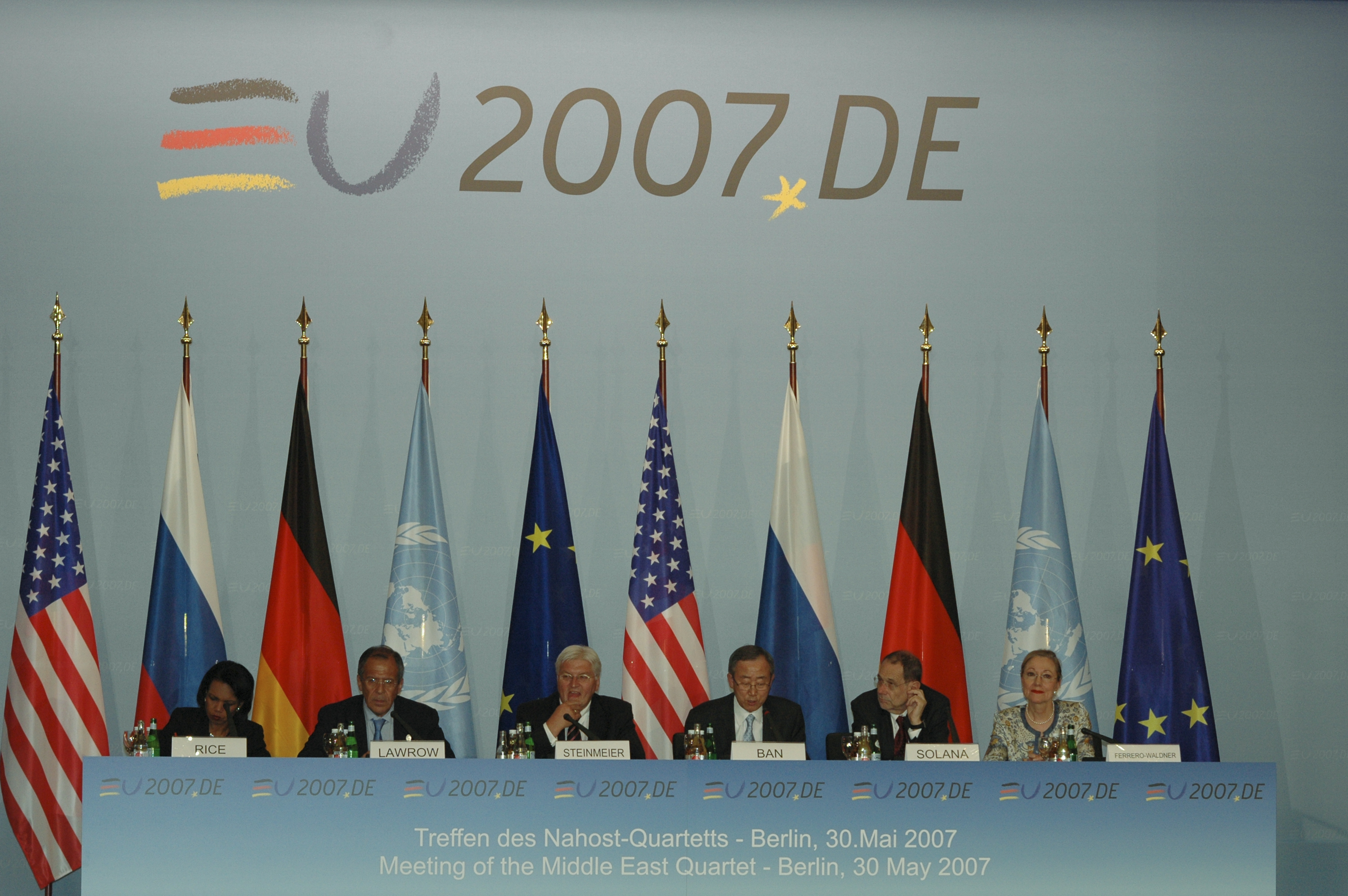 Lavrov - met today in Berlin. I've been accused of overindulging in Quartet textual analysis in the past, so I'll resist the temptation this time, and just point to a few noteworthy snippets.

 The head to head between Barak and Ayalon hardly offers two dramatic and radical competing visions for the Israeli future. Both come from a military background and both have been cautious in their messaging not to over-rock the boat, but there are real differences. Barak has been running on a ticket of experience, having already served as Prime Minister from 1999 to 2001. He claims to be a safe pair of hands to lead the country in a time of war, which is an unfortunate indication of where he intends to take the region. Ayalon has marketed himself as Mr. Clean, suggesting that he represents a new style of politics that stands in contrast to the scandal-ridden current leadership. Ayalon has never held Ministerial office and this is being used against him. Ayalon’s counter-argument is that Barak may have reached the pinnacle of the political pyramid, but that he was a failed Prime Minister.
 Goldstein of the "Moment" magazine about the late Jerry Falwell and his relations to Israel and the Jews. The title, "A Toxic Legacy," tells you where this is going. Here are some choice nuggets:
 Tomorrow Amir Peretz will almost certainly be voted out as the leader of Israel’s Labour Party and by extension as the country’s Defense Minister, as party members go to the polls in primary elections. Peretz has had a torrid time in the Defense Ministry. Even if he was dealt a harsh hand when the situation on Israel’s northern border spiraled into a crisis so soon after he entered office, Peretz has justifiably been criticized has having failed to show leadership, provide strategic direction, and stamp his authority on the military top brass. In his first senior government role, Peretz came up short.
 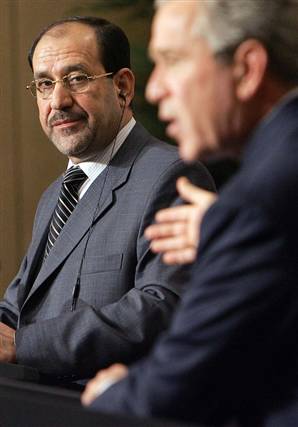 this specific compromise is based on a fundamental flaw -- namely, the benchmarks approach.
 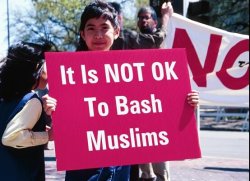 Homicide Bombings against Civilians."
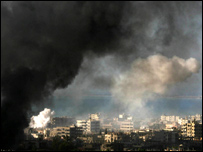 A battle is raging in the Northern Lebanese city of Tripoli between the Lebanese Armed Forces and militants from the little and little known movement; meanwhile two bombs have exploded in civilian areas of Beirut in the last 48 hours. The death toll in and around the Nahr Al-Bared Palestinian refugee camp in Tripoli, the center of the fighting, is unknown, but it already numbers in the tens.
  New York Times op-ed guru Tom Friedman can be frustratingly out of touch in his Middle East writing, but he does also have a refreshing ability to change tack - he has just done that, belatedly, on the question of how to 'deal' with Hamas. In his Sunday column, (subscription required) from newly appointed US war czar, Lt. Gen. Douglas Lute to the President.
 than the obvious.

 unwilling to do heavy lifting in Iraq, and the overall regional atmosphere will lurch again in the direction of violent radicalism.
  Jonathan Broder of Congressional Quarterly wrote this very insightful piece on where the debate is at in Israel. I'll give you a few tasters here, but the entire piece is worth a look:
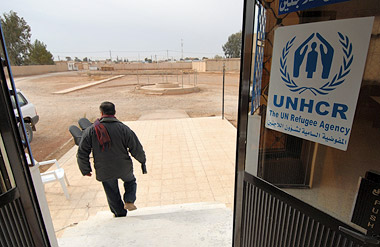 New America Foundation Fellow Nir Rosen has been out and about speaking on this issue. Rosen recently published an entitled “The Flight From Iraq,” the cover story for the May 13th issue of The New York Times Magazine. It is estimated that 4 million Iraqis have been displaced since the U.S. invasion of Iraq. 2 million of these are refugees outside the country, the majority of whom are living in Syria and Jordan, but not without profound effects on the states themselves and the region at large. You can check out a web-cast of the event .
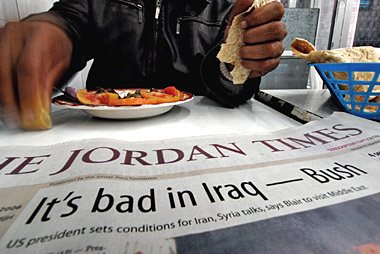 many of the Iraqis he interviewed now speak on sectarian terms, Rosen has noted that this classification of Sunni or Shi‘a was a rare -- if non-existent -- element in Baghdad before the invasion.
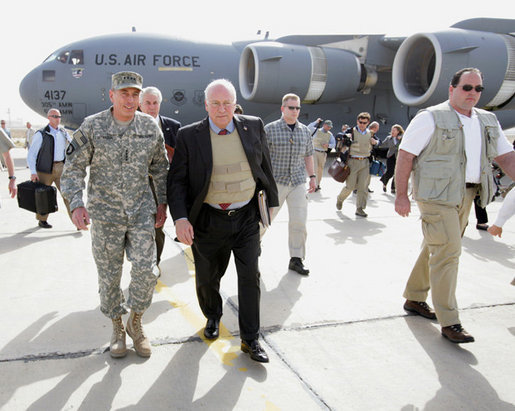 ic:
ic: It's worth checking out . Despite the weaknesses of leadership in the region, the revised Arab Initiative does offer a real opportunity which should not be missed, and that is again articulated by Siniora in his op-ed.
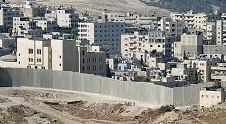 A report released today by the World Bank found that severe restrictions on movement and access continue to devastate the West Bank economy. "Without efficient and predictable movement of people and goods, there is very little prospect for a sustainable Palestinian economic recovery," according to the report.

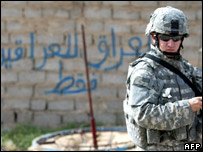 As the news breaks about President Bush’s veto of the Congressional Bill which attempted to link war funding with a timetable for U.S. troop withdrawal from Iraq, BBC News posted a about the President’s comments, including his feeling that the US “surge” of troops needs more time to work. Posted in the article was the following picture with the caption “President Bush has poured extra troops into Baghdad” below it. The English translation of the Arabic writing on the wall behind the armed troop in the picture reads “Iraq is for the Iraqis only.” The irony speaks for itself.