On Sunday, Israeli Prime Minister Ehud Olmert handed in his resignation. Israel’s Foreign Minister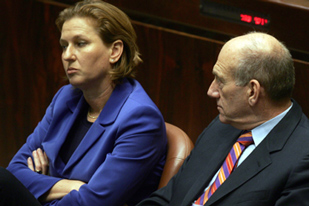 and the newly elected leader of the Kadima party, Tzipi Livni, has now been formally given the mandate by Israeli President Shimon Peres to build a governing coalition and thereby become prime minister. Despite the cloudy circumstances surrounding the departure -- he has faced ongoing corruption investigations -- Olmert’s style continues to win smiles. In convening the cabinet to inform them of his resignation, Olmert explained that there were a number of items on the agenda and proceeded to give a rosy update on a series of Israeli weekend sporting successes -- in the Para-Olympics, Davis Cup tennis, and the European basketball championship -- before getting to the final item on the agenda, his own political demise. The investigations against Olmert are the proximate causes for his downfall, even if they have a now familiar ring about them with his three predecessors (Sharon, Barak, and Netanyahu) all having faced not dissimilar allegations.
Israel now enters an unusual but far from unprecedented round of political maneuvering. Livni has twenty-eight days to garner a majority with of sixty-one members of the Israeli Knesset to support a new government which she would lead. That timetable can be extended by up to fourteen days. In other words, Tzipi’s deadline falls tantalizingly on November 3rd—the eve of you know what. If she succeeds, then her government could serve until the next scheduled election, not due until November 2010 (though such longevity is considered to be most unlikely). If Livni cannot form a governing majority then Israel will go to elections (theoretically, the President could give someone else a crack a trying to put a government together—realistically that will not happen). Elections would be held within ninety days, or on a date shortly thereafter, agreed upon and legislated by parliament—around late February or early March. A governing coalition then still has to be negotiated and formed after elections—in other words, this period of transition under a caretaker government could last through to April or even May 2009. Under this scenario, unless he agrees to make way for Livni (a sore point at this stage) or is indicted, then Ehud Olmert could well serve as caretaker Prime Minister for several more months.
Livni has already begun meeting with party leaders from the various blocs in Israel’s fractured Knesset in order to hit the magic number -- 61 -- needed to pass a parliamentary vote of confidence. So it’s time to schmooze with the Rabbis, the Pensioners, and most of all with the mercurial Ehud Barak, the Labor leader. But Tzipi’s options are somewhat limited. The most predictable way forward would be to maintain the existing coalition of Kadima (29 seats), Labor (19), the Sephardi-ultra Orthodox Shas party (12), and the Pensioners (seven), and perhaps add the left-wing Meretz party (five seats), which is already in conversation with Livni. The Likud and the rest of the right-wing and religious bloc are unlikely to give the Foreign Minister the added kudos of any time in the Prime Minister’s chair (the Ashkenazi, ultra-Orthodox United Torah Judaism party with 6 seats may be willing to cooperate if the price is right), while perhaps one or two of the three Arab parties, Islamist, post-Communist, and nationalist respectively, will at most offer ad hoc collaboration from outside the government. Basically, it boils down to striking a deal with the Labor and Shas parties. The latter is all about the sectarian interests of its core constituency (budgets to religious schools and institutions, special child allowances for large families, and so forth) but the party leans to the right, is under electoral pressure from Likud, and will try to trip Livni on the peace process and especially negotiations on Jerusalem’s future.
The Labor party, and in particular its leader Ehud Barak, are inhabiting something of a twilight zone. Barak has justifiably received some very bad press in Israel over the last couple of days. He held off agreeing to meet with Livni until after he hobnobbed with Likud leader Benjamin Netanyahu, and in consultations his party recommended to the President that he, and not Livni, be asked to form a government -- despite the fact that this is a legal impossibility, since Barak is not a member of parliament. Barak -- a former IDF Chief of Staff, former Prime Minister and now Defense Minister -- is not a happy camper. Labor under Barak lags a distant third in the polls. He is bereft of an agenda, and having led the ousting of Olmert, his initial refusal to cooperate with Livni comes across as transparently cheap politicking.
Worse than that, Barak’s approach to Livni seems to have a distinctly macho, sexist tone. As Israel’s leading columnist Nahum Barnea in the Yediot commented (referring to Barak), “The boys aren’t willing to accept a girl into their game.” It is hard to find a substantive reason why Labor will not to serve in a Livni-led coalition: Barak has no discernibly distinct policies on socioeconomic, security, or peace-process issues, and many senior Labor Party officials are cringing at their leader’s behavior. One issue that could become a flagship, and is promoted by some in the party, would be to oppose the judicial reforms being promoted that are designed to weaken the Supreme Court and to end the tenure of the controversial Justice Minister Daniel Friedmann.
Livni obviously wants a smooth process of government formation -- and it is equally obvious that her potential allies will not give it to her. The question, and Livni’s dilemma, is this: How much tarnishing should she endure in the coming weeks to have a shot at becoming prime minister before elections are held? If it does come down to elections, Livni will have stiff competition from the Likud Party, led by former Prime Minister Benjamin Netanyahu. Current polling puts Netanyahu ahead, but suggests a tight race with campaign lines being drawn around security, experience, and toughness (Bibi) versus clean politics, pragmatism, and not going back to a Bibi premiership (Livni).
Haaretz political analyst Yossi Verter has described Livni’s appeal as that of a “non-political politician” who “stands for something else…radiates integrity, an upstanding character, and credibility…a Mrs. Clean.” She does not enjoy any comparisons to Israel’s one previous female PM, the unpopular Golda Meir. So, what to expect if Tzipi Livni does form a coalition and become Prime Minister? She would have to assume that any coalition would not last the full two pre-election years and would thus need to chalk up some achievements in a relatively short period of time. The obvious arena, especially for someone with Livni’s Foreign Ministry experience, would be on the diplomatic/peace-process front. Livni would have to manage three tracks in which Israel is engaged -- peace talks with the Fatah-led Palestinian Authority in the West Bank, the cease-fire and prisoner exchanges with Hamas in Gaza, and the Turkish-mediated talks with Syria. And that’s without considering the potential for conflict with Iran.
Livni has established a reputation as a moderate -- a moderate who favored a diplomatic solution during the Lebanon War of 2006 (and led efforts to achieve UNSCR 1701 that ended the war), has led peace negotiations with the Palestinians, and has avoided and sometimes criticized the more bellicose Israeli rhetoric on Iran. She has traveled some distance from her right-wing Likud and roots. But what is not clear is whether Livni can continue that journey and embrace a set of positions that would allow closure between Israel and its neighbors – her red lines are not known on key positions such as one-to-one land swaps and minimal deviations from the 1967 lines including in Jerusalem, preventing settlements expansion, and actually implementing any agreed deal.
Livni’s enthusiasm for the Manichean division of the region into moderates and extremists is a cause for concern – the Middle East Israel inhabits is full of grey areas requiring pragmatic realism on Syria, Hamas, Iran and a host of other issues. Livni has not been a supporter of the cease-fire with Hamas, which, paradoxically, is one of Olmert’s more notable accomplishments. Hamas policy will be an early test for Livni -- and to succeed she will almost certainly have to understand, as many of Israel’s military chiefs have, that there are no good military options. In private she is said to be more open on the issue. On the Syria front, Livni has not been involved in the talks but has hinted that she would favor continuing them.
I would argue that a Livni premiership could be effective, constructive and even positively game changing – if she can transcend Israel’s dysfunctional political system and constant coalition bargaining. And a lot will also depend on America. Livni has been close to Secretary Rice, and it is fair to assume that many of her more significant foreign policy choices will be strongly influenced by whether she is interacting with a President McCain or President Obama. So even if some of Israel’s questions are answered by November 3, others will have to wait until November 4.