
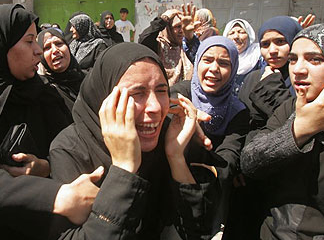
Gaza seems to be descending towards a civil war, Lebanon lurched closer to conflict with the and ongoing clashes at the Nahr El-Bared camp, and the Iraqi civil war, already long underway, took another desperate turn with the .
Each of these situations has its own complex circumstances and particular set of actors, causes, and dynamics. They cannot be neatly filed under one common rubric -- say extremists vs. moderates, or Iran vs. the US. Yet it is possible, perhaps, to discern at least one unifying theme: each of these conflicts is, in part, the pushback against the neocon transformationalist agenda for the Middle East. I am not suggesting that the US is solely responsible for the woeful state of the region, but the contribution of a mistaken and rigid ideological dogma applied to the region has been dramatic and devastating.
On Iraq, the case hardly needs to be made -- it is self-evident. On Lebanon, the isolation of and regime-change rhetoric towards Syria exacerbated an already tense situation, and has clearly failed to "correct Syrian misbehavior." In Gaza, the Bush administration policy of "no meaningful peace process under our watch," combined with support for Israeli unilateralism and, most recently, the destabilizing of the PA government, are all crucial to understanding the current Fatah-Hamas debacle.
Read this by just-deported UN Envoy de Soto for a clearer picture of what's going on.
On paper, at least, two possible US strategies might have been considered. One would be an assessment that the US-favored side could win an internal clash and would, therefore, be supported, funded, and armed toward that end. The other point of departure would be that a political accommodation and compromise between rival factions would ultimately be necessary, and that the best thing any US intervention might hope to achieve would be to strengthen the hand of its ally in advance of domestic political negotiations.
Given the apparent rigid opposition of the Bush administration to a political compromise between Fatah and Hamas, its rejection of the Mecca deal, and the embargo on the Unity Government -- it is apparently safe to assume that the second option was rejected. However, the first option, even ignoring considerations of the desirability or ethics of such an approach, simply makes no sense in the Gaza context. Currently Hamas clearly has the upper hand militarily, and that was predictable. But even if Fatah were in a stronger position, a military victory, if at all possible, would likely have come at a massive price in human terms but also in terms of social disintegration, and a likely after-effect of increased radicalization. So the US was encouraging a military confrontation that its favorite could not win, and was further muddying what would anyway have been a very difficult political accommodation.
Again, this is not to place the blame for the current mess all at the door of the Bush administration, but just to point out that US policy is playing a role, and a dreadfully negative one. In many ways, a very similar assessment can be applied to Lebanon, but more of that in a future post.

Comments (7)
No negotiation with a Zionist state is possible, never has been and never will be. Its actions have shown it unwilling to negotiate for a peace - only entrenching its desire for all of "Eretz Israel". Spend 5 minutes on the West Bank and you will understand this on a profound level. The idea of a "Jewish State" is a failure.
Posted by yasmin | June 14, 2007 5:51 PM
Posted on June 14, 2007 17:51
Absolutely right Levy.
What the Arab fractions do among themselves and the s*** stirring we in America have done in the ME are two seperate discussions.
So the Arabs may fight among themselves...
So What?
Is it the US's right or business to start or add to those conflicts so we can dominate the ME?
The answer is hell no.
And the absolute idioticy of thinking we can create more little US/Isr friendly installed regimes by chaos for "stability and security" is so stupid that...well..words fail me.
Posted by RB Renfro | June 14, 2007 3:11 PM
Posted on June 14, 2007 15:11
Although I'm sympathetic with most of what you say, I'm curious as to whether you think diplomatic engagement really would have changed anything. Would it have stopped Syria from killing this latest MP, or from being opposed to the UN tribunal? I mean, not too long ago we had Speaker Pelosi's visit to Syria, and her statement that "the road to Damascus is a road to peace." In the aftermath of that, little seems to have been accomplished besides making her statement, if not her entire trip, seem at best fruitless.
Posted by Steve W. | June 14, 2007 9:43 AM
Posted on June 14, 2007 09:43
You to see the May 15th Prophecy and how accurate it is on what is going on in Iraq,Lebanon and Syria and the return of the Hidden Imam
at lastdaywatchers.blogspot.com
Posted by | June 14, 2007 12:29 AM
Posted on June 14, 2007 00:29
I enjoy your blog but this post raises an issue which bothers me: you give no credit to the Muslims (Palestinians, Lebanese, Syrians, Iraqis, Iranians) for their choices. You implicitly argue that the US or Israel or someone in the West, stirred up a nest of bees or made a pack of dogs angry. In other words, these people aren't responsible for their choices, but the West is. That reflects a deep cultural bias and is not helpful. The Iraqis choose to kill each other. The Lebanese have chosen to maintain the Palestinians in what the UN describes as outdoor prisons, creating the conditions which enable Fatah al-Islam. Hamas chooses violence.
Posted by jonathan | June 13, 2007 11:22 PM
Posted on June 13, 2007 23:22
I see it as a region-wide struggle between "militias/parties" and "states/governments". The struggle seems to be over whether governments and states will have a monopoly on the legitimate use of force in these areas, or factions will. Thus, an "institution-building" strategy that strengthens states and state administration seems to be the natural starting point for US foreign policy. Unfortunately, that's a 5+ year process, and unlikely to work during a shooting war. That should have been our regional strategy in 2002, not invading Iraq.
Posted by gfw | June 13, 2007 10:37 PM
Posted on June 13, 2007 22:37
Mr. Levy seems to be laboring under what I consider to be a delusion, namely that Hamas can somehow be persuaded to reverse its opposition to the existence of the State of Israel. I would like to know on what basis Mr. Levy has arrived at such a conclusion. I see no evidence of this, particularly as long as Khalad Maashal calls the shots from Damascus. In fact, since they are winning the civil war with the Fatah forces, and, given the relative success of Hizbollah in Lebanon last summer and the incompetence of the Olmert government, they feel that they can eventually defeat the IDF through an attrition strategy also.
Posted by SLC | June 13, 2007 7:49 PM
Posted on June 13, 2007 19:49